Showing posts with label Big Ideas. Show all posts

Tell Lots of Stories

Story Time
Photo courtesy of Scottish Libraries
Peter Guber and Bernadette Jiwa have really got me thinking about just how powerful stories can be, not only in building a brand, but in having an impact on the people around you.

Stories are powerful because our brains are hardwired to grasp them easily.

Before the advent of the written word, human beings told oral stories for tens of thousands of years. That's how we survived and endured -- by learning through stories.

Stories cut to the chase.

Even the most complex or technically convoluted concepts can be easily understood if presented as a story. Case in point, you can expound about the wonders of your product  or service 'til you're blue in the face and many customers will still not understand. Tell them a story, on the other hand, and they will instantly "get it".

Stories are just more fun.

They entertain and enlighten. They help you to be at your persuasive best. They give you the power to break old paradigms by allowing your audience to place themselves in the role of the protagonist in your story. You have them in rapt attention. Empathy increases. Understanding ensues.

So given the power of stories, you need to ask yourself two critical questions:

(1) Am I telling enough stories?
(2) And are they good ones?

Your Customers: Satisfied or Happy?

Have you ever thought about the difference between customer satisfaction and customer happiness? 

I think it’s becoming increasingly clear that customer service needs to evolve from satisfying customers to wowing them, thrilling them, and making them truly happy to work with you.

That’s because customers who are merely satisfied aren’t loyal. If your competitor decides to drop his prices, many of your “satisfied” customers will leave you. They’re content – that is, until something better comes along. 

Happy customers, on the other hand, are loyal. 

They’re your raving fans. You get them and they get you. They’re “evangelists” for you cause. They’ll help you spread the word about how great you are because they have a stake in your product and your business, and they know that you care about them as well.

Case in point: take a look at what the guys from 37Signals are doing on their website. Not only do they aim to make their customers happy, they publish their happiness ratings online for all the world to see.

That keeps them honest.

And that’s a good thing because it’s easy to talk a good game about wowing customers but not easy to get it done.

But keeping customers happy is a must now, not a nice-to-have. In a market saturated with capable competitors, the last thing you want your company to be is just “OK” in the eyes of customers.

You want them to see you as great! Awesome! Remarkable! Worth raving about!

I know it’s not easy, but what are you doing to move in that direction? 

And by the way customer service applies, not just to external customers but to internal customers as well- your teammates, co-workers and direct reports! Remember to WOW them too!

The King's Speech

In case you haven't seen King's Speech, I recommend you run to the nearest theater and go check it out.

Not merely because it just won an Oscar for Best Picture, or because Colin Firth's performance as King George VI is sublime, but rather because there's a HUGE message about courage, conviction and overcoming the fears that hold you back.

The King's Speech is the story of Prince Albert Duke of York's ascent to the throne in 1936, on the eve of the horrible 2nd World War.

People were worried.

Prince Albert was brave, dutiful and brimming with patriotic conviction. He was perfectly fit to be king, save for one GINORMOUS flaw: he was a horrible stammerer and just about the worst public speaker anyone ever saw.

Prince Albert simply dreaded speaking in public. In the movie, you can see the life drain from his very soul at the mere sight of a microphone. 

And part of the movie's raw power is that we can all relate in varying degrees to the Prince's fear. People say they fear public speaking more than death itself!

But there's a problem with that. If you want to make a greater contribution; if you want to make a greater impact and make more of a "dent in the universe" you're going to have to face this, or any other fear, and master it.

I've learned this lesson firsthand.

When I was a kid I had a pretty bad speech impediment. I spoke too fast. I blurred my words. I stuttered mildly. They sent me to speech therapy sessions a couple of times a week.

But that wasn't all. I used to have a horrible fear of public speaking. And it wasn't those cute little butterflies in your stomach. It was primal, run-for-your-life, Freddy Krueger type fear. The kind where your hands shake uncontrollably and your mouth turns into the Saharan desert. 

The funny thing is that people often comment on how comfortable I am as a public speaker. Little do they know that what they perceive as innate talent or skill is actually the result of countless hours of facing my demons, pushing myself, practicing, studying, embarassing myself, and daring to try again.

Like The King's Speech shows, it's okay to be afraid. But it's not okay to let that fear limit what you can become.

Just look at at what great people like Richard Branson or Temple Grandin have been able to accomplish despite very serious limitations. They've had the courage to push themselves to do more, and in doing so have changed the world.

You can do it too.

But when in doubt, you'd do well to recall the words of another great contemporary of George VI: "The only thing we have to fear is fear itself."

3 Essential Ways to Boost Your Productivity

People with Evil Plans keep busy. Probably too busy. But keeping busy doesn't equate to being effective or productive.

The key to your success is finding ways to maximize your productivity while minimizing unnecessary stress.

It's possible, and it's downright necessary if you're looking to make a dent in the universe.

So to be more productive, there are 3 essential things you must do.

1. Disconnect
Einstein once said that "We can't solve problems by using the same kind of thinking we used when we created them." It's so true. It's so easy to get sucked in and get caught up in our momentum. The days rush by as we're propelled forward, but in what direction? Are you on track or have you veered off the right path?

You have to disconnect frequently to reassess and plan a more sensible approach. Disconnect a couple of times a day for a few minutes and reassess your effectiveness. Are you just putting out fires or are you working on things that will yield results today AND in the future?

You can also disconnect frequently to take a high level look at your work. Do this on a weekly, monthly or yearly basis. Do it as much (or as little) as you need to feel comfortable that you're on the right track. And remember that rest and leisure are your friends. They'll help you renew and refocus your energy.

2. Singletask
Multitasking is the enemy. It only creates the illusion of speed and actually wears you down. You spin your wheels frantically and don't get very far. It brings unnecessary stress and saps your creative powers. So instead of diluting your energy, focus it! Work on one thing at a time. Focus. Ignore the phone. Turn off email. Don't instant message. Get it done, then move on to the next truly productive task.

3. Batch
Bundle similar tasks together and get them done in one shot. If you have multiple errands to run, batch them together and schedule a single block of time to check them all off your list. At work, don't check email sporadically throughout the day or as they come in. That kills productivity. Instead, block off specific times to deal with email and then shut it off. This'll free up blocks of uninterrupted time to work on your projects.

One last word. All this may sound simple, but it's not particularly easy to do. It takes discipline and determination. So ask yourself, how badly do you want it?

What Is It That Only You Can Do?


Washington gives up his military command.
The other day I was reading the Harvard Business Review and came across an interesting interview with John Mackey, Co-CEO of Whole Foods Market.

In the interview, Mackey stated the he often asks himself the question, "What Is It That Only I Can Do?

Great question.

Because of his unique expertise, vision, perspective, position and talents, he identifies what it is in the organization that only HE can do to make progress and gets busy doing it.

Interestingly, when George Washington attended the Second Continental Congress in May of 1775, this very idea was also at work.


Because of all these factors, leading the Continental Army was something only George Washington could do. And after his hard-fought victories on the battle field, only he could lead the nation as its first president.

Washington made history once again in 1783 when he ceded his commission as Commander-in-Chief of the Army to the Congress. It was something only Washington could do--relinquish military power so as to send a clear message: the United States was to be led by civilians and not military dictators. 

Washington did what only he could do. How about you?

Given your unique gifts, talents, background, and experience, I can assure you that there's something that needs doing that only YOU can do.

Will you identify what that is and take it upon yourself to do it? You might just make a little history.

Happy President's Day!

Mondays are Made for Love: Happy Valentine's Day!

Happy Monday! And Happy Valentine's Day too!

And how appropriate - in my mind, love and Mondays always go together.

That’s because we all know it's easy for everyone to say "TGIF" or "Happy Friday".
But it's not as easy to say "Happy Monday" and mean it.

When you utter the words Happy Monday, what you're really saying is:
1. My work isn't drudgery, it's exciting!
2. My work is important and it matters to me, and to others.
3. I have an opportunity today (and all week long) to make someone's day.
4. I have a chance this week to design or launch something special, and
5. I LOVE my work and can't wait to get to it!
Sound idealistic or overly romantic? It's not.

The world rewards companies and people who inject genuine LOVE and passion
into what they do. "Me-too" products, and services, and resumes pale by 
comparison and the market responds accordingly. People will pay the bare 
minimum for mediocrity, but they'll pay a king's ransom for things powered
by L-O-V-E.

And because it's so rare, you can spot love in business from a mile away.

It's the big, bright smile and friendly service you get from the flight
attendant. Or the enthusiasm and energy of an inspired presenter at 
a seminar. Or the fantastic service and incredibly fresh food you get at your 
local farmers market.

And your customers know if you love your work, or not. And they flock to
businesses where they sense that love. That's why if you pour your heart into
whatever you do, you are way may more likely to win than if you don't.

But there's a catch. In order to get to the point where you love what you do, 
you have to be willing to take some risks.

You have to go out on a limb and risk failure. You have to be willing to lead, 
to do things differently, and to realize that there are no guarantees. Love
isn't all rosy. It can be a thorny business.

Maybe people will think you're idea isn't so great. Or maybe your product will 
fall flat, despite your hard work and dedication.  Hey, it happens, and then we 
have to get over it.

Steve Jobs got over it. After being ousted from Apple and then floundering with 
NeXT, he bounced back in spectacular fashion. He kept at it and followed his heart.

No surprise there. Courage, strength, and resilience are important components
of love. Did you know that the very word Valentine comes from the Latin
valentia which connotes courage, strength and ability? 

So loving what you do isn't a frivolity or a nice-to-have. It's a prerequisite
for your success. We ignore this maxim at our own peril.

Ask yourself, do I love what I do? It's worth thinking about for a few seconds.

Now I'll leave you with something very profound that Steve Jobs said about all this
in a 2005 commencement speech at Stanford: 

For the past 33 years, I have looked in the mirror every morning and asked 
myself, "If today were the last day of my life, would I want to do what I am 
about to do today?" And whenever the answer has been "no" for too many 
days in a row, I know I need to change something. 

Remembering that you are going to die is the best way I know to avoid the 
trap of thinking you have something to lose. You are already naked.  

There is no reason not to follow your heart.

Happy Valentine’s Day and have a fantastic week!


8 Songs That Will Energize and Inspire You

Photo by Gary Simmons
Today is party day on planet earth.

On New Year's Eve we say goodbye to 2010 and celebrate the arrival of hope, opportunity and a brand new year. And central to this global celebration is... music!

But I'm not thinking about the kind of music that's "got a good beat that you can dance to." I'm thinking more about popular songs that have something profound to say in addition to a great beat.

I'm thinking of music that can form the soundtrack of your life in 2011 as you seek to be happy, healthy and prosperous.

Here are 8 of my favorite popular songs that will energize and inspire
you.

(1) You Gotta Be - Des'ree
In this smooth and soulful tune, Des'ree implores you to push yourself and avoid complacency. "Challenge what the future holds" and "stand up and be counted". Do you need to step up your game in 2011? This song will inspire you.

(2) Unwritten - Natasha Bedingfield
I love this song, not only because of it's clever, hip-hoppity beat, and shiny acoustic guitar (not to mention the rousing chorus near the end) but because of it's moving message about enjoying the present as you work to create the future of your dreams. "Today is where your book begins, the rest is still unwritten." "Unwritten" reminds us that your future is yours to write if you'll only release your inhibitions. Brilliant song, and you can cut a rug to it too!

(3) Make it Happen - Mariah Carey
Although this song is a bit melodramatic, I still love it for it's message of faith - faith in yourself and a higher power. It's like a groovy, danceable version of Amazing Grace which reminds us that we will, at times, be severely tested. But..."If you believe in yourself and know what you really want you're going to make it happen." Prayer. Faith. What else is there to say?

(4) Vogue - Madonna
This song seems like just a fun, danceable track and nothing more. But listen carefully and you'll hear an empowering message about pushing boundaries, having fun, and doing it with style. Like Gene Kelly and Fred Astaire, don't forget to imbue everything you do in 2011 with grace and style.

(5) I Hope You Dance - Lee Ann Womack
I adore this song. The lyrics are so beautifully poetic and poignant that I get goose-bumps each and every time I listen to it. I love the message, Lee Ann's loving rendition, the soft, country-music arrangement... everything. This is the theme song for LIFE, yours and mine. But will we always remember to dance?

(6) Man in the Mirror - Michael Jackson
Leo Tolstoy, Gandhi and Michael Jackson agree. Everyone's out to change the world, but few ever think of changing themselves. If you want to make the world a better place, start with the man or woman you see in the mirror. Be the change you seek to see.

(7) Shining Star - Earth, Wind and Fire
There's more to this rock and funk classic than some wickedly funky bass lines and electric guitar. The song reminds us of what Carl Sagan was fond of saying: "You're made of star stuff!" Indeed, every atom in your body was created in the furnace deep inside of a star. Amazing. Call it a miracle or call it an act of God, but you're a star, metaphorically and literally speaking. Although you may sometimes forget, you're always capable of shining very bright.

(8) A Whole New World - Peabo Bryson and Regina Belle
This gorgeously arranged and performed tune reminds us of the importance of love and how love can open your eyes to a whole new world of possibilities, if you let it. And it doesn't have to be romantic love. It can be love of self or of your fellow man. Or love of your craft. Let love open your eyes wide so you can get a better look at this wondrous world we live in.

So there you have my 8 songs, but I'm looking for more. Do you have suggestions?

Have wonderful and blessed New Year!

Understanding Your Time Perspective

Time is something we talk about a lot. We talk about spending time, losing time and not having enough time.

I think Professor Phillip Zimbardo, has a very interesting take on time. And I believe he has important things to teach us about  how we perceive time,  and how those perceptions can help us become happier and more effective.

In Zimbardo's 2008 book, The Time Paradox (co-authored with John Boyd), he argues that most people have a “bias” for one of 6 time perspectives:

  1. Past Positive - focused on the pleasant memories and positive experiences of the past;
  2. Past Negative - focused on past traumas or painful memories;
  3. Present Hedonistic - focused on seeking pleasurable experiences in the moment;
  4. Present Fatalistic – focused on lack of control in the present and a "it doesn't matter" view of present actions
  5. Future - focused on discipline and hard work today in order to achieve rewards in the future;
  6. Future Transcendental – heavily focused on a belief in the afterlife; 

The trick, according to Zimbardo is to limit an unhealthy bias towards any one of these time perspectives and to be able to fluidly move from one perspective to another, as the situation requires.

In other words, there’s a three-pronged “optimal time perspective” which will help you stay balanced, successful and happy:

  1. Past Positive - High
    People who view their past as happy tend to exhibit less anxiety, are less aggressive, have more energy and are perceived as friendlier than those who view their past negatively. Interestingly, research suggests that even people who experienced hardships in the past can become past-positive if they can frame their negative experiences in a positive light.
  2. Present Hedonism - Moderate
    Actively seeking pleasurable experiences and doing things that give you enjoyment can help you stay balanced and energetic, but focusing too much on such activities can lead us to "avoid things that require high effort and maintenance, or are that are regularized or boring." Moderation is key.
  3. Future – Moderately High
    Being focused on the future is all about delaying gratification today for a greater reward in the future. Future-based people are good at "planning, scheduling one's time wisely, and anticipating detours and traps that might appear on the path to success". Futures are great problem solvers, know how to persevere and generally make more money than those in the other time perspectives. But again, moderation is the key. Being too focused on the future can lead us to "trade off social pleasures, like spending time with family and friends." Many futures also have a tendency to disregard their own health and spiritual well-being. 
Now, here are three things you can do to enjoy the present while engaging in activities that provide future benefit in your life.

  1. Try to focus more on the good things that happened in your past and practice giving thanks for everything positive that’s come your way.
  2. Take some time each day to slow down, relax, have fun and “smell the roses”. Think of actions you can take in the present that will not only help you feel good now, but that will also help you achieve future goals (e.g. taking a brisk walk with two of your best friends).
  3. Set S.M.A.R.T goals for yourself then make a plan and work a little each day to execute  that plan. A mere 1% improvement per day (or per week), can add up to impressive progress at the end of just one year!
Time is a non-renewable resource. Learning to use it wisely pays huge dividends. 

Happy Monday: The First Penguin

I’ll never forget the late Professor Randy Pausch talk about his “First Penguin Award”, which he gave to students in his virtual reality class for daring to do something bold and risky with their group projects.

Penguins, we all know, are cute and lovable critters, but they're also quite the tasty treat for the leopard seals who hide stealthily beneath the surface of Antarctica's frigid waters. The seals lurk, happily waiting for their meal to take the plunge.

The first penguin risks life and limb to keep his rookery safe. And while his valiant exploits may not always end happily, the first penguin's work and sacrifice helps ensure the survival of his kind.

Fortunately for us, we don't operate in this frozen and inhospitable world, but in the world of business, it sure can seem like it.

The seals are there, lurking in the form of economic upheaval, fast-paced technological disrruption, and growing competitive and commoditization pressures.

Professor Pausch understood the importance of encouraging the brave and the bold. Although their pioneering efforts sometimes fell flat, it was okay. They were trying to push the bar higher for everyone’s sake.

They weren't just playing it safe, they were trying to do something new and different. They were hypothesizing and experimenting. They were testing possibilities. They were contributing.

That's leadership.

Learning to make mistakes, and learning to learn from those mistakes.

You should strive to be that first penguin and you should encourage and reward the other first penguins around you.

Ask yourself, what risks am I taking in my career and in my business? What new initiatives, products or services am I launching and testing (and re-launching if necessary)? How am I pushing to add value to all stakeholders. Am I leading my industry, my customers, my vendors, my co-workers, or are am I just playing it safe?

What’s stopping you from making something truly meaningful happen?

Fear?

Ok, but remember that playing it safe may be the most dangerous and fiercest seal of all.

Have a great week!

The Most Important Question Biz Owners Can Ask

Whenever I have a chance to talk to small business owners, I challenge them to answer a simple but penetrating question: "What do you REALLY sell?"

Starbucks, for example,  doesn't really sell coffee, they sell how people feel when they lounge in their stores. Harley Davidson certainly doesn't sell motorcycles, they sell how you feel when you parade around town on one of their bikes. And Fedex doesn't sell shipping services, they sell the peace of mind of knowing your valuable package is safely on its way (and guaranteed to reach it's destination on time).

How do your products or services make your customers feel?

To further illustrate my point, I love what Apple just did with their announcement of the Beattles long-awaited arrival on iTunes.

Apple's home page a few days ago didn't have nary a picture of one of its products and instead featured a gorgeous, black and white photo of the young Beatles which can't help but trigger feelings of nostalgia and memories of youth, or innocence, or wide-eyed idealism.

And Apple's promotional videos feature some of The Beatles most memorable songs. The visuals show The Beatles collaborating and smiling - ostensibly focused on a labor of love. These ads are positively drenched with feeling and emotion, which apple leverages to connect to its brand.

It’s dynamite!

Apple clearly understands what it REALLY sells and it's not computers or smart phones. It's much more than that, and we all sense what that is.

So my challenge to you is to think about what YOU really sell.

Maybe you're not a business owner, or are technically NOT in a sales organization, but if you have co-workers, or speak to customers, (or have kids) you're in sales just the same. The question applies to you as well. We're all in sales, aren't we?

So think about the services you render for others and distill it right down to how your services make others feel. Think about the  emotional impact of your work because that's REALLY what you're selling and, hopefully, you're helping them feel like a million bucks!

If you passionately pour yourself into your work and you consistently connect with their hearts, you'll have customers who'll gladly pay a premium, and will follow you loyally for a very long time.

How to Start a Movement

I came across the video of Derek Sivers' Ted Talk and just had to share it. It's a fun but poignant illustration of just how difficult (and easy) it is to inspire change.


The video raises some pretty provocative questions for leaders EVERYWHERE.

Here are just 4 of them:
  1. Are you authentic enough, and comfortable enough with yourself, to truly lead and be that "lone nut" that gets it all started?
  2. Do you have the humility to embrace others as your equal, especially your early followers and contributors?
  3. When you see someone go out on a limb in order to accomplish something worthwhile, do you have the courage and conviction to lend a hand. Will you follow, even if it means being ridiculed or sacrificing your own interests?
  4. Are you quick at spotting growing opportunities and getting involved while you can still make a difference?
If you really think about it, this isn't a funny video about some shirtless guy dancing on a grassy hill and the throngs of people that descend upon him. It's an invitation to look in the mirror. 

In your industry, in your company, or in your personal life. What role are you playing?

Get out there and start dancing!

Aversion to Change and an Appetite for Self Destruction

I was on David Bustle's blog reading his post The Death of a Professional and that got me thinking about the massive cost of ignoring change in your industry, and in your life.

I think I've been lucky. I learned about the importance of embracing change when I was just 7 years old!

For as long as I live, I'll never forget the day my family was forced to leave our homeland of Nicaragua, back in the late spring of 1979.

That was the day that the Sandinista leftist-guerillas were on their way to capture Nicaragua's capital, Managua. My parents had largely ignored the civil war that had been raging in the countryside for years. My dad, a decorated army officer, never thought the rebels would be successful in overthrowing the government, until it finally happened.

No one believed it was possible until, of course, the levies broke.

I was awakened at 3:00 AM  that spring morning and rushed out of bed. We left for the airport in haste under the dark cold of night. By late afternoon we found ourselves in a strange land (Guatemala), far from home and nearly broke. We left behind family, our home and all the possessions which formed the trappings of a comfortable upper middle class existence. And we didn't know if we would ever return or what would become of us in the difficult days, months and years that surely lay ahead.

That's my family's story, but failure to embrace change is not a phenomenon confined to geo politics. You see this all the time in business, in industry after industry.

For example, I heard Steve Knopper on Book TV talk about his new book, An Appetite for Self Destruction. He was eloquently discussing how the recording industry was not merely a “victim” of piracy, and the unreasonable desire of consumers to acquire music cheaper, or even FREE, via Napster and other peer-to-peer sites.

In fact, the record industry had ample warning from knowledgeable employees and other business leaders and industry insiders. The alarms were definitely sounding but they chose not to listen until it was too late. They didn’t embrace change or emerging technologies. It took an outsider in a totally different industry (Steve Jobs) to help them sort of get their act together.

Why does this happen?

I think it’s because people get too comfortable with their current arrangements. They can’t stand the thought of their bubble being burst. They stay there in their comfort zones until it can no longer be helped. That’s when fear of change morphs into the fear of NOT changing. But fear, it seems, is always the fulcrum that leverages change.

That's unfortunate.

I see it happening now with Social Media. Lots more people are getting serious about it but the vast majority of business owners I interact with still don't see how it's relevant to their business. They see it as complete waste of time. They don't quite grasp that buy not addressing (if not embracing) these new tools what they're actually doing is giving the competition a chance to score points at their expense. They're leaving the door wide open for someone else in their market space to take the lead, and eat their lunch.

And it's tougher the older we get. That's why I said that I was fortunate to have learned this incredibly valuable lesson at such an early age. I learned that if I could survive as a refugee I could survive anything. If I had to pack up my bags right now and move to China, I know I wouldn't spend a second lamenting my predicament. I'd embrace my new reality and get to work.

Luckily, most of us are spared the realities of these extreme scenarios. Still, change is all around us.

Are you paying attention? Are you embracing change? Or are you lamenting your shrinking market share, your dwindling profit margins, the proliferation of competitors, the bad economy, whatever. We live in a world of abundance, so why are you focused on scarcity?

My advice to you is simple and cliched, but nonetheless true: grab the bull by the horns before it's too late!

Marathons and Pushing Beyond Your Comfort Zone

I was supposed to run the Marine Corps Marathon last October but a bout with tendonitis kept me from achieving my goal. Today I registered again and I'm back in training! I'm very excited!

Of course, lots of people think that running marathons is pretty darn nutty. They can't even begin to understand why anybody would want to put their bodies through the considerable stress and pain that accompanies covering the 26.2 mile distance.

Well, I like that it's hard.

Running marathons requires focus, commitment, planning, and discipline-- precisely the ingredients that contribute to success in any endeavor.

And I tend to think of marathons as a metaphor for the challenges we all face in our lives. It takes guts to reach for ambitious goals but running a marathon teaches you that hard work and commitment are always rewarded. The unsavory alternative is to stay in our comfort zones and never test the limits of what's possible, or what we're capable of.

Marathons remind me that big, audacious goals aren't achieved overnight. They require preparation and a commitment to working hard every day.

But it's not all serious. It's also fun to be active. You may struggle at first but with every passing day your fitness level increases and running becomes more enjoyable.

That's the way it is with most things, isn't it? They're hard at first but easier (and more fun) as time goes by.

And maybe running isn't your cup of tea, but I'm sure there's something out there that you want to do but you're not doing it because it lies outside your comfort zone. Commit to it. Practice a little every day. Make a plan and work it.

You'll be amazed at what you're able to do.

See you at the finish line!

Fees, Fees and More Fees?

In a precedent-setting move, Spirit Airlines has announced that they will soon start charging their customers up to $45 for carry-on luggage. Wow!

As fares come down, airlines seem to be compensating by turning bag fees into a veritable industry worth an estimated $2 billion a year, according to the Department of Transportation.

How wise is this move? Not very...


The logic is convoluted. The same airline that has $9 dollar fares is also more than happy to nickel and dime it's customers to make up for the lost revenue? Cheap fares but high fees for everything else means you're not competing on price nor value-add. This makes flying a boring point A to point B proposition, and about as exciting as getting on a crowded city bus.

I like Southwest's strategy much better.

They compete on price, yes, but they have radically changed their operational structure in order to win at that game. Case in point, Southwest doesn't fly everywhere. Instead, they focus on a limited but profitable number of popular airports and destinations.

In addition, Southwest has a fleet of 500 jets and all of them are Boeing 737s. This means that parts and personnel are interchangeable, which leads to high efficiency and much lower operational, maintenance and training costs.

And because the airline was designed from the ground up to compete on price, they've managed to stay profitable, while keeping customers smiling. Bags fly free, customers get to pick their favorite seat, the peanuts and soda are on the house, and the planes arrive on time.

It's certainly not first class, I know, but it's a fun and economically beneficial experience.

The moral of the story...never try to compete on price unless you're ready to walk the talk and still turn a healthy profit.

The Guys at 37 Signals Really Break it Down in REWORK!

If 7-UP was the "un-cola" then Jason Fried and David Heinemeier Hansson's REWORK is the un-business book.

In other words, it's unlike any business book you've ever read, and that's a very good thing

It's piercingly original, smart, thoughtful, edgy, iconoclastic, funny, profound, profane, persuasive, AND, surprisingly inspirational. Whew!

In other words, you need to read this book! Period.

The powerful advice contained in its pages applies to would-be entrepreneurs, CEOs, marketers, customer service personnel, HR reps, or just about anyone who has anything to do with running a business. Inside you'll find clever advice you won't hear anywhere else:
  • Planning is guessing
  • Why grow?
  • Fire the workaholics
  • Make a dent in the universe
  • Scratch your own itch
  • Outside money is Plan Z
  • Emulate drug dealers
  • Meetings are toxic
  • Go to sleep
  • ASAP is poison
These nuggets of wisdom are brought to you by the two guys who founded 37 Signals, a small but very successful software company who's built a loyal following by creating innovative and highly usable software that empowers people to manage their projects, track their interactions with customers and collaborate more effectively.

You can probably read 5 or 10 regular business books and not glean as much shrewd advice as you can  from Fried's and Heinemeier Hansson's work. These guys have broken all the rules and won.

But not only that, we live in a world where the old rules don't work anymore and the new rules aren't always clear. That's why REWORK is an important book for you to have. It cuts through the noise. These guys have mapped out some of the new terrain and it's a map very worthy of your consideration.

Also, check out this 30 min interview with Jason Fried.

President Obama Sets Example on Workplace Flexibility

President Obama made me proud yesterday when he tackled the issue of workplace flexibility and promised to set an example for other chief executives to follow. In a bold and innovative move, he committed to allowing federal employees in "Washington DC and all across America to telework on a regular basis".

This is an idea whose time has come.


More and more businesses are finding that fostering a flexible work environment is key in helping them retain top talent, reduce employee turnover and absenteeism, and increase productivity.

Yes, I said increase productivity.

Many studies, as well as anecdotal evidence from some pretty great companies, suggest that executives and business owners have little to fear. Instead of becoming less productive, having flexible work hours, and the ability to work from home, seems to encourage more engagement, loyalty and productivity among workers. Many even report preferring flexible workplace options over salary increases - not a bad bargain considering the present economic climate.

I think we need to start realizing that what matters are results and productivity, not when employees clock in and clock out. Also, how and where work is being done is becoming increasingly irrelevant, especially as liberating technological breakthroughs,and the realities of a globalized business environment erode the foundation of the old 9 to 5 workday paradigm.

President Obama's Forum on Workplace Flexibility was a shot across the bow. It's time to realize that  this isn't just good for companies, it's good for our families, and it's good for our country.

Let's face it, the world has changed and the world of work is changing with it.

Career and Job Advice in a Manga! Thanks Dan!

When I was a kid, I loved reading comic books like Spiderman and the Xmen. In fact, my dream was to one day move to New York City to create and illustrate stories for Marvel Comics. That hasn't happened yet but my point is that I've always had a soft spot in my heart for the medium.

So imagine my surprise, and delight, when I came across Dan Pink's The Adventures of Johnny Bunko, a Japanese manga, which builds on some of the concepts espoused in his earlier book, A Whole New Mind, and which manages to proffer some very useful and pithy career advice.


Here's the premise: Johnny Bunko is a pretty good (albeit somewhat dense) kid fresh out of school who is now suffering in his cubicle at the Boggs Corporation. He works on endless reports and excel spreadsheets for a depostic and clueless boss.

Johnny is desperate, and in pain, because he's toiling for long hours working on things he doesn't particularly like or isn't particularly good at. What ensues is a playful tale involving magical chopsticks, a genie slash career counselor, and 6 valuable lessons no one ever bothered to teach Johnny (or any of us, for that matter).

Cool stuff indeed!

I believe that Dan Pink has become a must-read author like Seth Godin and Chris Anderson. When these thought-leaders have something to say, you better believe that I'm ALL ears. I buy everything they produce, no questions asked.

And I love that Pink seems to be fully incorporating the ideas that he explored in a Whole New Mind (which I will tackle in a forthcoming post). He's tapping into his creative and artistic side and has produced a unique work in the vein of past books like Eliyahu Goldratt's The Goal and Kenneth Blanchard's Who Moved My Cheese. These books not only tackled meaty business issues but did so with creativity and panache.

I recommend you read Johnny Bunko for yourself and then pass it on to a high schooler near you.

And on a related note, we should all try to be a little more creative and artistic at work. We're all born artists afterall, and while we can't all work at Marvel Comics, you have creativity and art in you that can enhance your place of work or your business.

Dan Pink's teaching us not to be afraid to work with the right side of our brain. It's a lesson worth taking to heart.

Undercover Boss: The Power of Connecting with Your Employees

I don't know what got into me, but something prompted me to check out the reality TV show, Undercover Boss on CBS.com. You know, this is the show where CEOs take on the guise of regular, entry-level employees and go deep undercover to behold their enterprise from a vantage point they rarely, if ever, appreciate.

I found the show to be both shamelessly exploitative and emotionally manipulative, and yet also surprisingly enlightening.

I watched the episode featuring Michael Rubin, CEO of the billion-dollar e-Commerce company GSI. During the course of the show's 40 minutes, Rubin struggles to load a truck, feels the stress of dealing with customer complaints, is inspired by the skill and positive attitude of several of his employees, and is enraged when he witnesses a call center representative mistreat a customer.

At the end, in predictable fashion, he reveals his true identity to his employees and showers them with the requisite financial rewards (except for the rude customer service rep, she gets somewhat of a stern rebuke).

Is it hokey? Yes. Is it all bad? No.

I am convinced that if CEOs took the time to appreciate and connect with their employees the way these shameless promoters (a.k.a. "undercover bosses") have done, a couple of pretty profound things would happen:

(1) Bosses would be blown away by the quality of some the people on their payroll and the extent to which these star performers are under-appreciated and under-utilized. They'd become more adroit at spotting these gems and maybe even at developing them into good organizational leaders.

And...

(2) Employees would be mightily impressed with the boss' sincere efforts to connect with them on a more emotional and human level. They would begin to see their boss as more of an engaged, and caring human being, and less as a detached, insensitive suit with a big title.

Employees are hungry for this kind of connection with their leaders, but many leaders are unwilling, or too fearful of appearing weak or soft, to try it out. It's far easier, as Rubin aptly points out, to sit in the corner office staring at forecasts and barking orders.

Yet studies like the one conducted by Jim Collins and expounded upon in his book Good to Great reveal just how critical this Level 5 leadership is to building great companies. It turns out you can be a tough as nails CEO like former Southwest Airlines chief Herb Kelleher and still embody the virtues of humility, empathy and understanding.

Such a leader can work wonders in an organization and they're desperately needed - especially in this hyper-competitive, globalized and inter-connected world where being "good" is not nearly good enough. Your company should be aiming for greatness!

Companies need a CEO who values and connects deeply with his people and allows them to be co-authors of the organization's customer-centered future. This is probably THE most important work a CEO can do and all too often it's relegated to the back burner, far behind more "pressing matters".

And so the vicious cycle continues...until someone, maybe an entry-level employee, comes along and has the guts to lead and be the catalyst for change.

Who knew a reality TV show could actually teach us something? Stay tuned.

Do What You Love

I was listening to a tribute to Alex Chilton on NPR's Fresh Air with Terry Gross today. Chilton was a very influential singer, songwriter and guitarist who passed away last week. Only 59 years young, he was supposed to perform at the SXWS festival but instead was remembered there for his many contributions to the music world.

As a member of the Box Tops he had some very early commercial successes. In fact, I was amazed to learn that he performed the hit song, The Letter, when he was just 16 years old!


After the Box Tops, Chilton started a band called Big Star which created some memorable works, none of which propelled Chilton to commercial stardom.

But although the big record deals and commercial successes never materialized, he nevertheless was true to his love of music and that came across to the many musicians he influenced over the years.

Chilton seemed content with the cards he had been dealt. It was a good deal. He carved out a niche for himself that allowed him to perform around the U.S. and the world.

He got a chance to devote himself to his art.

It didn't bring him material riches but he was comfortable enough financially to be able to devote his life to doing what he loved most.

Similarly, I remember listening to an interview with author George Pelecanos who said that he didn't really care all that much about commercial success. He wanted every book he produced to be successful enough to give him the chance to write another one.

You should remember that creating art is its own reward. I think Seth Godin's got it right in his new book Linchpin: Don't be afraid to express yourself...to do your art and to fully use your gifts. Do what you love, radiate that love, and material success will follow.

If You're In Business You Need to Read This Book!

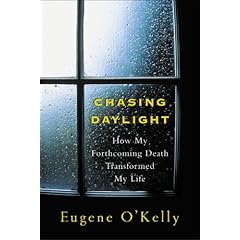
I just finished reading Eugene O'Kelly's moving and thought-provoking book Chasing Daylight: How My Forthcoming Death Transformed My Life.

In June of 2005, O'Kelly, the highly successful CEO of KPMG, one of the nation's top accounting firms, was given some bone-jarring news. The doctors told him that he had a glioblastoma, a type of cancer that uses glial cells to wage war against the healthy cells in the brain.

And the tumors where doing their work with ruthless efficiency. Neither surgery, nor chemo or radiation, would do much good. His life was just about over, the doctors told him, he had 2, maybe 3 months to live.
"Wow. Is there any way, really, to prepare for the suddenness? To have that tucked-away fear that lives constantly in all of us - that a calamity can happen, technically, at any moment - be transformed, within days or moments, into reality? To have that fear that you can bury at least sometimes, even most of the time, explode into a new state of being that you can't deny for even a second?

It was beyond jarring...I'd been catapulted into the last phase of my life, the one where I was supposed to be wise - wise for my daughters, my grandchildren, those younger than me. Except I'd missed a key stretch of life and still had a lot to learn.

But that was where I was. And if I was going to be of any use to my daughters, especially Gina, and to my friends and colleagues, and to Corinne, whose preternatural wisdom I'd relied on for so long, I had better get used to where I was fast."
O'Kelly pursued dying as he did living, with passion, focus, and, true to his Type A personality, a deep-seeded obsession with setting and achieving goals.

He went immediately to work. The book documents the process of his "unwindings" and his struggle to stay clear and level-headed while fighting the ravages of his disease.

But despite the struggles, he insists that his diagnosis was actually a blessing. He was lucky in that his tumors did their work without inflicting much pain. And he adds that his sense of what's truly important and the importance of savoring perfect moments was heightened to levels most people are unable to achieve in life.

He sometimes pauses, though,  to wish he had spent more days with his wife Corinne chasing daylight out on a beautiful golf course, or spent more time creating and savoring perfect moments in everyday life.

"I was just too caught up in my fast-paced, high-pressure life to ever get at the sublimeness that was embedded in them," he writes.

But ultimately, O'Kelly was succesful in meeting most of his goals during his transition. Although he went about it with an accountant's sense of focus and strict discipline, it ultimately allowed him to inject meaning into the process and create peace and a sense of closure.

Although he died in September of 2005 without finishing the book (his wife wrote the last chapter) he left this world at peace knowing he had done everything he could do. He slipped away gently on September 10th.

It's not easy to think about the end, it's much, much easier to avoid "tucked-away fears", but I think it's crucial for us to STOP and reflect on how we're living today. Eugene O'Kelly died at peace because he didn't have any great regrets and what others might have seen as a curse he saw as a gift. Wow! There's amazing lesson in that for all of us.

He accepted responsibility for his condition without lament, and did the best to live out his remaining days with love and dignity.

I highly recommend that you read this book. It's Eugene O'Kelly's gift to all of us.